

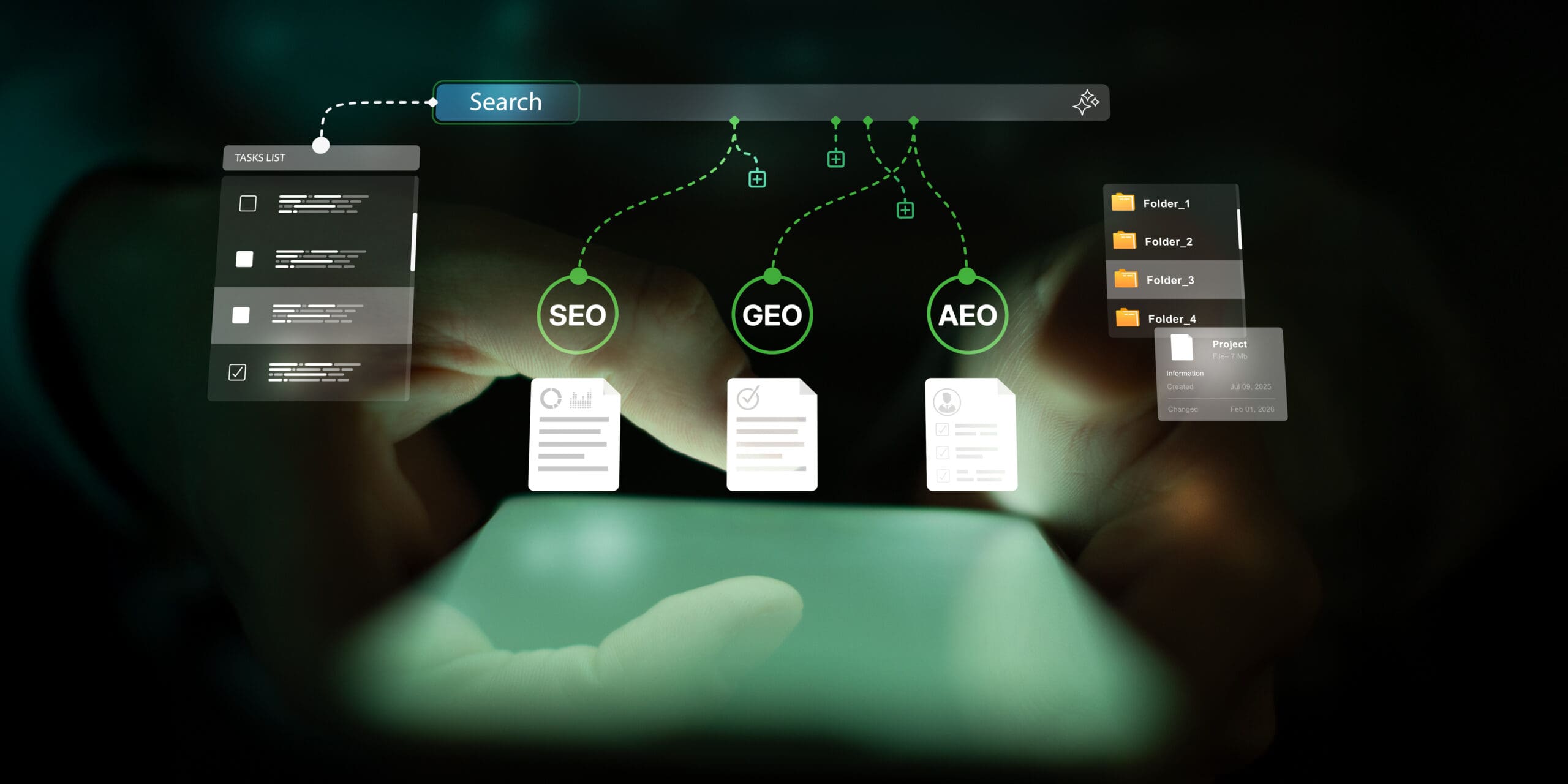
If you have been hearing more terms like SEO, AEO, and GEO lately, you are not alone.
A lot of business owners are trying to make sense of how search is changing as Google adds more AI features and more people start asking questions in AI-powered platforms.
The good news is that this does not mean SEO is dead.
It means search is evolving.
And businesses that understand the difference between SEO, AEO, and GEO will be in a much better position to stay visible online.
What Is SEO?
SEO stands for search engine optimization.
Traditionally, SEO is about helping your business show up in search results when people look for products, services, or information related to what you offer.
That usually involves improving things like:
- website structure
- page quality
- keyword targeting
- local SEO
- technical performance
- internal linking
- content creation
- authority and trust signals
The goal of SEO is usually to help your website rank well in search engines so people can find your business and click through to your site.
SEO still matters because search engines still send traffic, and visibility in traditional results is still a major source of leads for many businesses.
What Is AEO?
AEO usually stands for answer engine optimization.
This is the practice of making your content easier for answer-based systems to understand, extract, and cite when users ask direct questions.
In simple terms, AEO is about helping your content become the answer, not just one of many links.
That often means creating content that is:
- direct
- clear
- structured well
- easy to scan
- built around real questions
- trustworthy and specific
AEO is especially relevant as people use voice search, AI search features, and answer-focused interfaces that try to provide a direct response instead of just a list of blue links.
What Is GEO?
GEO usually stands for generative engine optimization.
This term is generally used to describe optimizing your brand and content so AI-driven search and chat systems are more likely to discover, understand, reference, and cite your business in generated answers.
If SEO is about ranking in results, GEO is more about being included in synthesized responses.
That means GEO is often connected to platforms and features where AI pulls together information from multiple sources and presents an answer with references, summaries, or recommendations.
Why These Terms Matter Now
Search behavior is changing.
Google now includes AI features in Search, including AI Overviews and AI Mode guidance for site owners, and Google says site owners should focus on unique, valuable content for people rather than trying to produce pages specifically for AI experiences. (developers.google.com)
At the same time, Bing’s webmaster guidance explicitly says its guidelines apply across Bing search experiences, Copilot, and its grounding API, which shows how traditional search visibility and AI-powered experiences are becoming more connected. (bing.com)
That is why businesses are hearing more about AEO and GEO in 2026. They are trying to adapt to a world where people may find brands through classic search results, AI-generated summaries, and conversational answer engines. (searchengineland.com)
So, Is SEO Still Important?
Yes. Absolutely.
SEO is still the foundation.
If your website is weak, your technical setup is poor, your content is thin, your business lacks trust signals, or your local search presence is weak, that usually hurts everything else too.
In many cases, AEO and GEO are not replacements for SEO. They are extensions of the same core idea: make your business easier to find, easier to trust, and easier to understand online. That framing aligns with guidance from Google and Bing, which continue to emphasize quality, discoverability, and useful content. (developers.google.com)
How SEO, AEO, and GEO Are Different
Here is the simplest way to think about it:
SEO
Focuses on ranking your pages in traditional search results and earning clicks.
AEO
Focuses on helping your content answer specific questions clearly enough that answer engines can extract and surface it.
GEO
Focuses on helping AI-powered systems discover and reference your brand or content in generated responses.
The overlap is significant.
All three benefit from high-quality content, strong trust signals, clear site structure, and real expertise.
What Businesses Should Actually Do
Most businesses do not need three separate strategies with three separate teams.
They need one strong content and visibility strategy that includes:
- strong website fundamentals
- useful, original content
- clear answers to real customer questions
- location and service pages that match search intent
- trust signals like reviews and expertise
- clean site structure and crawlability
- content formats that are easy for both users and machines to understand
That approach supports SEO and also gives your content a better chance of being useful in answer-driven and generative search experiences.
What Content Works Better in an AEO and GEO World?
Businesses should think more intentionally about content that answers real questions clearly.
That can include:
- FAQ sections
- comparison pages
- service pages with specific answers
- pricing and process explanations
- expert articles
- location-specific pages
- clear definitions and step-by-step posts
This does not mean writing robotic content for machines.
It means writing genuinely helpful content in a format that is easy to understand and easy to reference.
What Not to Do
Do not panic and throw out your SEO strategy.
Do not assume GEO means publishing a huge volume of AI-generated content.
Google’s guidance says using generative AI is fine when it helps create helpful content, but scaled low-value content can violate spam policies. (developers.google.com)
So the goal is not more content for the sake of content. The goal is better content that reflects real expertise and helps real people.
What This Means for Small Businesses
For small and local businesses, this shift is actually an opportunity.
You do not need to outpublish massive brands on every topic. You need to be clearer, more useful, and more trustworthy in your niche and market.
A local business that publishes strong service pages, clear FAQs, strong reviews, and well-structured helpful content can still compete effectively in both traditional and AI-influenced search environments. That direction is consistent with search engine guidance emphasizing useful content and site quality. (developers.google.com)
Final Thoughts
SEO vs. AEO vs. GEO is not really a fight.
It is a progression.
SEO is still the base. AEO helps your content become more answer-ready. GEO helps your brand stay visible as AI-generated discovery grows.
The businesses that win will not be the ones chasing every new buzzword. They will be the ones building strong websites, publishing useful content, answering real customer questions, and making their expertise easier to understand online.
That is what works in any version of search.
FAQ: SEO vs. AEO vs. GEO
Is SEO dead in 2026?
No. SEO is still a core part of online visibility and remains the foundation for being discovered in search.
What is the difference between SEO and AEO?
SEO focuses on helping pages rank in search results. AEO focuses on helping content answer questions clearly enough to be surfaced directly by answer engines.
What is the difference between AEO and GEO?
AEO is usually more focused on direct answer extraction, while GEO is more focused on being referenced or cited in AI-generated responses and conversational search experiences.
Do small businesses need to care about GEO?
Yes, but not as a completely separate strategy. Small businesses should focus on clear, trustworthy, useful content and strong website fundamentals first.
What type of content works best for AEO and GEO?
Content that is well-structured, specific, useful, trustworthy, and built around real customer questions tends to work better.
Should businesses use AI to create content?
AI can help with research, drafting, and structure, but the final content still needs to be original, useful, and genuinely valuable to users.
What is the best place to start?
Start with strong SEO fundamentals, then improve your content so it answers real questions clearly and credibly.